Français



How to Play Tower Rush One Floor at a Time
In the original game from Galaxsys, you start your own tower with one stake and decide whether to build again after each successful floor. If you want to learn how to play Tower Rush in France, begin with the FUN balance. You can follow the entire sequence from the first Build to the final entry in History using virtual credits.
Tower Rush Game Play in Five Steps
A round begins when the server accepts your first Build. Before you start, check the game name and the unit on the balance. Tower Rush game play uses a single panel with manual Build and Cashout controls. You can see the floor drop from a crane, but the server determines the result.
- Open the demo and check the unit. Select the original Tower Rush by Galaxsys and look for FUN on the balance. Open Rules to check the stake range and maximum payout for that mode.
- Select a stake. Choose an amount on the stake grid shown in your demo. The logged FUN configuration used 1 to 100 FUN in steps of 0.50 FUN. Check the amount beside Build before pressing it.
- Press Build once. Once the server accepts the round, the game debits your stake and drops the first floor. A successful placement applies that floor’s multiplier to your stake. If the first floor falls, the round ends with zero gross payout.
- Choose Cashout or Build after a successful placement. Press Cashout to request settlement at the confirmed amount, or press Build to put the current unprotected amount at risk on the next floor. The next Build belongs to the same round.
- Check History after the round ends. Match the round entry to your stake and the confirmed result. A successful Cashout immediately credits the gaming balance and returns the game to its starting state. A fall also closes the round, with a payout only if the round already has Frozen protection.
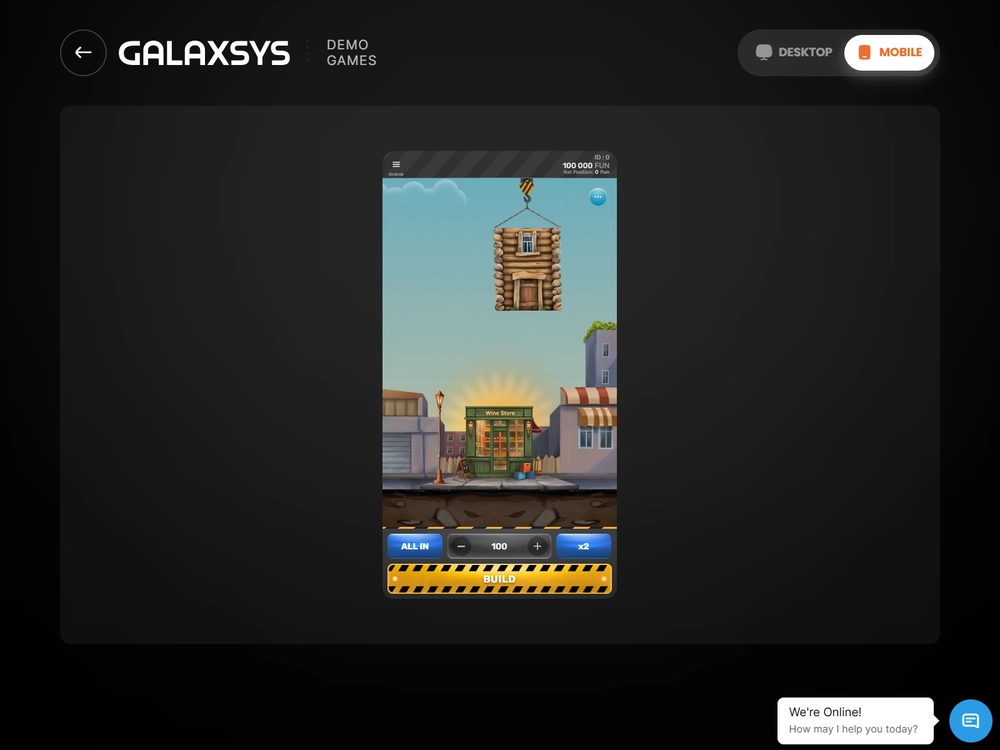
The floor animation and the balance entry can appear at different moments. When a tap seems to hang, check the original round before trying again. Check your own round in History. The Players and Top views in the demo show other activity, which has no bearing on whether your request was accepted. When the round closes, look for the payout or refund on the entry with your stake.
What Changes After Each Build
The first accepted Build debits the stake. Each successful floor applies its own multiplier to the amount available to cash out. A 1× multiplier leaves that amount unchanged. For instance, the Galaxsys desktop demo displayed 1.60 FUN after a 1 FUN stake reached 1.6×. A further 1.45× took that amount to 2.32 FUN.
Even a floor that stays up can shrink the offer. In that desktop demo sequence, a later 0.45× floor took a displayed 2.43 FUN down to 1.09 FUN. Read the amount beside Cashout after each placement. Tower height alone cannot tell you whether the offer rose, fell or stayed at the same value.
The original has one set of controls. You choose each Build yourself and make a manual Cashout request after a successful floor. The window closes when the server settles a fall. There is no common flight countdown or shared crash point to track, and the original has no automatic target that will submit Cashout for you.
| Stage | What the game records | What you can check |
|---|---|---|
| First Build accepted | One debit for the selected stake | The original round entry and stake |
| Another successful floor | A new multiplier applied to the running amount | The updated Cashout offer |
| Cashout confirmed | The final gross payout credited to the gaming balance | The settled amount in History |
| Fall without Frozen protection | Zero gross payout | The closed round and the loss of the stake |
| Fall after Frozen | The protected amount as the final payout | The single gross credit |
| Technical cancellation | A refund of the original stake | The returned stake and void status |
Why the Mode Matters in France
If you are in France, use the FUN demo because none of the ten operator profiles assessed for this market offers an authorised real-money route for Tower Rush. Betclic’s French permissions cover sports betting, horse racing and poker. A game listing, a French interface or a balance displayed in euros does not establish authorisation for this title.
Start with the FUN marker even if you reached the game through a French-language menu. The demo balance has its own unit and history. A credit there remains virtual, and the isolated EUR examples below explain arithmetic in a separate configuration. Use the Tower Rush overview to check that you have the original Galaxsys game.
How the Game Calculates Your Payout
The game starts from the accepted stake, applies the successive floor multipliers and settles one gross payout under the rules of the mode you opened. To calculate the net result on a settled round, subtract the original stake from gross. A void follows a separate refund path.
Gross, Net and the Maximum Win Limit
Gross is the full payout credited at settlement. In one mobile FUN round, a 15.50 FUN stake cashed out at 1.4× for 21.70 FUN gross and 6.20 FUN net. At 1× the same formula gives a gross payout equal to the stake and a net result of zero. A positive credit in History therefore tells you that the game paid something. Compare it with the stake. A positive gross below the stake still leaves you with a net loss.
For a normal Cashout, multiply the stake by the cumulative multiplier, apply the payout cap and read the credited gross to the nearest 0.01 unit under the logged configuration’s rounding rule. Maximum Win caps the gross payout per round. Galaxsys specifies no limit on the number of floors. You can still build after the warning, so an unprotected amount can disappear in a fall even when it has reached the limit.
| Configuration | Stake range and step | Gross payout limit per round |
|---|---|---|
| Galaxsys demo ledger, FUN | 1–100 FUN in 0.50 FUN steps | 10,000 FUN |
| Isolated settlement ledger, EUR | €0.50–€50.00 in €0.05 steps | €2,500 |
The EUR cap example uses a €50.00 stake and a raw cumulative multiplier of 64×. The uncapped amount is €3,200. Applying the €2,500 limit leaves €2,500 gross and €2,450 net. That payout equals 50× this stake. Treat 50× as the effective ratio for this calculation because the cap is set in euros and the ratio depends on the stake. Likewise, a 10,000 FUN payout limit is a figure in virtual credits. A separate FUN comparison profile used the same cap and 1–100 FUN range but a 0.25 FUN step. Use the stake grid shown in the mode you opened.
What Frozen Floor Protects
Frozen Floor fixes the amount accumulated at the point it activates. The Tower Rush game rules make that amount payable if a later floor falls. If you build further and successfully cash out a larger amount, the final payout already includes the protected amount. Frozen can occur once in a round. After it activates, further bonus floors stop appearing, and subsequent floors either fall or return at least 1.5× when they land successfully.
I recorded a protected fall in the mobile FUN demo. The 12.50 FUN stake reached 2.5×, fixing 31.25 FUN before the tower fell. The round credited 31.25 FUN once, so the net result was 18.75 FUN. The credit came from the earlier Frozen state. A protected amount belongs to the current round and clears when that round ends.
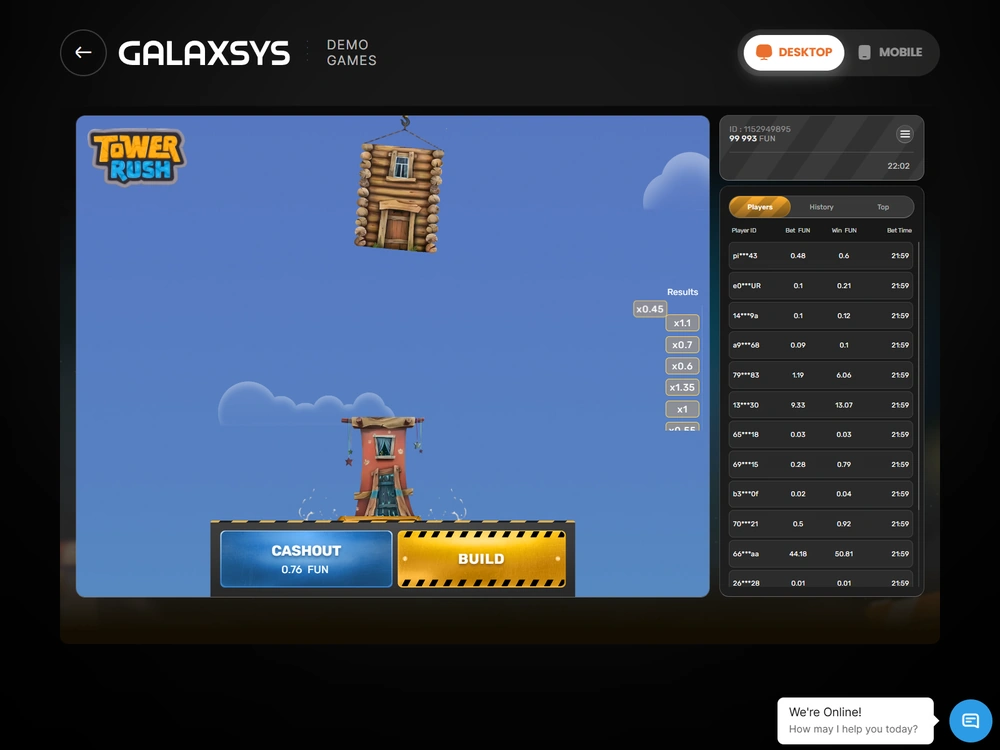
The two 17.50 FUN control cases show how the result changes when you continue after the same Frozen multiplier. A fall pays the protected 43.75 FUN. If the next floor lands at 1.5× and you cash out, the cumulative multiplier is 3.75×. The raw payout of 65.625 FUN rounds half-up to 65.63 FUN. Adding 43.75 FUN again would double-count the protection.
How Temple Floor and Triple Build Enter the Calculation
Temple Floor applies a wheel outcome to the running amount, and Triple Build adds three floors to the existing round. A bonus floor initially looks like an ordinary floor and reveals its type after a successful placement. Temple spins automatically once per activation. Its ten sectors show two each of 1.5×, 2×, 3× and 5×, one 7× and one Frozen. The sector count describes the layout. Actual odds depend on the weights assigned to those outcomes.
On a 12.50 FUN stake, reaching 2.2× before a Temple result of 3× gives a cumulative multiplier of 6.6×. Settlement at that point gives 82.50 FUN gross and 70.00 FUN net. A Frozen sector would instead protect the amount already accumulated when the wheel stops.
Triple Build’s three extra floors each have a multiplier of at least 1×. In the mobile demo ledger, one 3.50 FUN round logged 1.2×, 1.25× and 2× for a combined 3×. It paid 10.50 FUN gross and 7.00 FUN net on one debit. Both Temple and Triple Build can recur in a round before Frozen ends further bonus floors. See the bonus-floor mechanics for the details of each feature.
| Mode and outcome | Stake | Settlement basis | Gross | Net |
|---|---|---|---|---|
| FUN control case, Frozen then fall | 17.50 FUN | Protected at 2.5× | 43.75 FUN | +26.25 FUN |
| FUN control case, Frozen then Cashout | 17.50 FUN | 2.5× × 1.5×, rounded at settlement | 65.63 FUN | +48.13 FUN |
| FUN control case, Temple | 12.50 FUN | 2.2× × 3× | 82.50 FUN | +70.00 FUN |
| Isolated EUR control case, capped payout | €50.00 | 64× raw, capped at €2,500 | €2,500 | +€2,450 |
What the Mobile Demo History Shows
In 27 minutes on a Samsung Galaxy S25 FE, I logged 24 accepted rounds in FUN. Of those, 23 settled and one was voided. I started with 750.00 FUN. The initial debits totalled 254.00 FUN and the void returned 4.00 FUN, leaving 250.00 FUN in settled stakes. Gross payouts totalled 283.44 FUN and the closing balance was 783.44 FUN, with no stake pending. A separate demo reset took the balance from 783.44 FUN back to 750.00 FUN. The −33.44 FUN adjustment was outside round settlement.
Thirteen of the 23 settled rounds paid something. Twelve finished above the stake. The difference was a 5.00 FUN Cashout at 1×, which credited the stake amount and left a net result of zero. The largest gross payout was 44.10 FUN on a 21.00 FUN stake at 2.1×. The session recorded two Frozen outcomes, one Temple and one Triple Build.
The session’s gross divided by settled stakes was 113.38%, with a net gain of 33.44 FUN. The FUN ledger and isolated EUR ledger both use 97% as their theoretical long-run return. The session figure describes one set of rounds. For the difference between observed return and theoretical return, see the RTP and game maths.
For an illustration in euros, compare two theoretical returns on the same €250 of turnover with no cap reached. At 97%, the expected gross is €242.50, for a net of −€7.50. At 96.2%, the expected gross is €240.50, for a net of −€9.50. These are averages for the comparison, separate from the formula that settles an individual round.
What Happens if a Round Freezes or Disconnects?
Before server acceptance, a disconnect leaves no new debit. After acceptance, look up the original round in History if the screen freezes or the connection drops. A frozen screen and Frozen Floor describe different events. Only the bonus protects an accumulated payout.
In the mobile FUN test, I recovered the History entry after returning to the game from the background. The 18.50 FUN round settled at 1.55× for 28.68 FUN gross and 10.18 FUN net. In a separate FUN disconnect control case, History showed an accepted 6.50 FUN stake and a settled 1.8× result, giving 11.70 FUN gross and 5.20 FUN net. Reopening the same round displayed the existing result, which was credited once. If the connection stays down for an hour after an accepted stake, the rules settle the round after an hour of inactivity and credit any registered win.
Technical cancellation has its own balance entry. In the mobile test, I recorded a 4.00 FUN refund on a voided round, leaving its net result at zero. In a separate control case, a 13.00 FUN stake stayed pending until the round was voided and the full stake returned. If the protected payout had already reached the cap and the round had settled, a repeat request would also retrieve the existing settlement. If History and the balance disagree, keep the original round ID. See the troubleshooting guide.
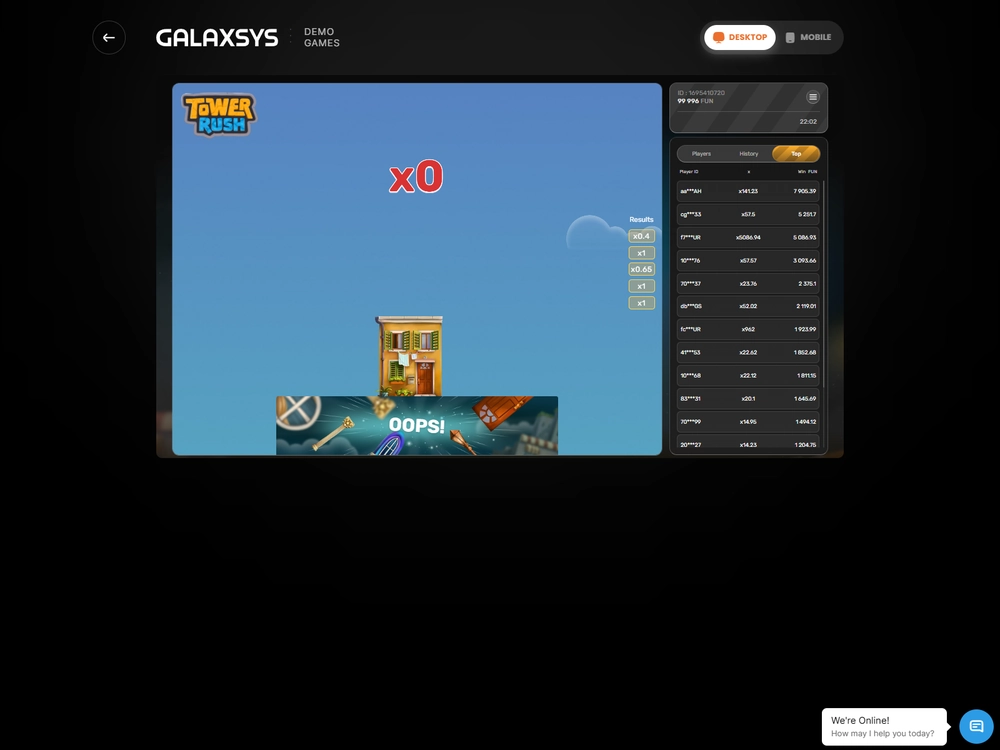
Where Cashout Sends the Payout
Cashout settles the round to its gaming balance. In the demo the balance is in FUN, so Cashout credits virtual units there. A withdrawal uses a separate cashier request and its own status. For the cashier process, see the withdrawal guide.
Try the Round in FUN
To learn how to play Tower Rush from France, follow one FUN stake from Build to settlement. Check the FUN marker at the start and compare the final entry in History with your stake. You can find the desktop and mobile routes in the official demo guide.

FAQ
Does Build charge a new stake for every floor?
The first accepted Build charges the selected stake once. Further floors belong to the same round, including the extra floors from Triple Build. A new stake is charged when you start a new round and the server accepts it.
Can a late Cashout pay after a floor has fallen?
Once the server has settled the fall, a later Cashout request cannot add another payout. Check History for the result on the original round. If Frozen Floor activated earlier, the protected amount is credited through that same settlement.
Can I cash out half of the accumulated amount?
The original game has no half Cashout option. The 50% Cashout feature belongs to the separate sequel, Tower Rush 2. Check the full game title when you open the demo so you follow the rules for the right version.
Does a refunded stake count towards settled demo turnover?
A technical refund cancels the debit for turnover purposes in the FUN ledger. A 1× Cashout still counts because the round settled. Both can leave your balance unchanged, which is why the outcome label in History matters.

| Author | Gaspard Joly |
|---|---|
| Role | Senior iGaming, gambling and betting analyst |
| Experience | 9+ years analysing game providers, online gambling and payment systems |
| Published | 10 November 2026 |
| Device | Samsung Galaxy S25 FE, Android 16, One UI 8 |
| Methodology | Methodology |
Play responsibly
 Play responsibly
18+. Gambling can cause financial and personal harm. Set personal limits. For support, visit GamCare or GambleAware. See responsible gambling in France for local options.
Publisher and supplier licence
Digitain (MT) Limited · Malta Gaming Authority
MGA/B2B/592/2018
Tower Rush France is the publisher of this site. Galaxsys supplies the game. The Malta Gaming Authority issued critical gaming supply licence MGA/B2B/592/2018 to Digitain (MT) Limited on 29 January 2020. The company is registered in Malta under C 87254 at Tower Business Centre, 2nd Floor, Office 230, TRIQ IT-TORRI, Swatar Birkirkara, BKR 4013, Malta. Its UK Gambling Commission account number is 63601.
This B2B licence covers game supply. French operator permissions are listed separately by the ANJ. Malta Gaming Authority licence register · ANJ operator register