Français




Published Tower Rush RTP ranges and profile settings
The Tower Rush RTP on the Galaxsys game card is 96.2–97.6%, while the provider’s demo rules and one of its catalogues give a narrower range. Those figures describe published ranges. The theoretical RTP is the share of settled stakes the model expects to return over repeated play. Use the rate assigned to the specific integration for that calculation.
| Publication or listing | RTP shown |
|---|---|
| Galaxsys game card | 96.2–97.6% |
| Galaxsys product PDF | 95.1–97.6% |
| Galaxsys demo rules and separate catalogue edition | 96.17–97% |
| SlotCatalog | 96.12–97% |
| Casino Guru | 97% |
| Stake international game card | 97% |
The Stake figure applies to its international listing of the Galaxsys original. France is excluded under Stake’s terms. Betclic’s French authorisation covers sports betting, horse racing and poker. An interface in French or a balance in euros can identify the language or wallet currency, but market authorisation comes from the ANJ register.
The integration sets the mathematics and you choose a stake on its permitted grid. Check that the selector shows FUN before using the demo controls. The demo has no round counter that switches it to another RTP. Resetting the wallet restores its balance and leaves the mathematical configuration in place. Even two FUN profiles with the same stated return and payout ceiling can have different stake increments.
| Profile | RTP used | Stake and increment | Gross cap per settled round |
|---|---|---|---|
| Demo session in FUN | 97% | 1–100 FUN in steps of 0.50 FUN | 10,000 FUN |
| Separate game comparison in FUN | 97% | 1–100 FUN in steps of 0.25 FUN | 10,000 FUN |
| Isolated EUR settlement profile | 97% | €0.50–€50.00 in steps of €0.05 | €2,500 |
| Alternative EUR expectation case | 96.2% | €250 of equal turnover for the comparison | Calculated without reaching a payout cap |
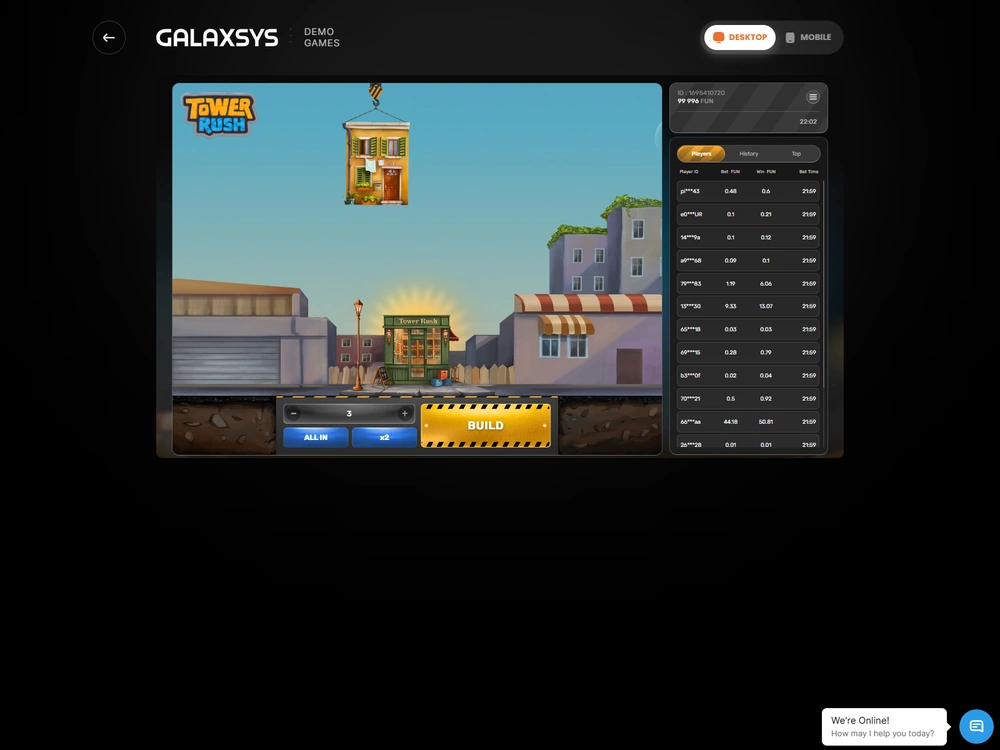
The two EUR rows serve different purposes. The first gives a stake grid and a payout limit for a settlement calculation. The second supplies a comparison rate for the same turnover. Neither provides a French play route. The original has no game jackpot, so the adopted RTP has no separate jackpot component. Tower Rush 2 and Tower Rush Branded have their own product identities.
How a stake becomes gross and net
Gross is the single final payout for a settled round. Net is gross minus the original stake. The first accepted Build debits that stake once. Each successful floor multiplies the amount already accumulated. You can then select Cashout to settle the round to the game balance, or choose another Build. A fall pays zero unless a Frozen Floor has protected an amount.
Use the exact product of the applicable multipliers, apply the gross cap and then round half up to the nearest 0.01 of the profile’s unit. For the capped EUR example, a €50.00 stake at a raw 64× gives €3,200 before the limit. The round settles at €2,500 gross and €2,450 net. The credited gross divided by the stake is 50× in that example. At a different stake, the same monetary cap gives a different effective ceiling.
That distinction also matters when a catalogue gives a cap as both a currency amount and a multiplier. SlotCatalog’s description pairs a €0.01–€100 stake range with a €10,000 cap and a 100× ceiling at the €100 maximum stake. Its separate listing attributes display a 0.4–400 range in dollars, euros and pounds. Use the stake grid and cap from the same profile when interpreting a multiplier. Reaching the maximum in the original can bring up a warning. Further floors cannot raise the credit above the cap, and continuing can still put unprotected winnings at risk.
How the bonus floors change the arithmetic
Frozen Floor protects the amount accumulated when it appears. In my demo, a 12.50 FUN stake at 2.5× gave a protected gross payout of 31.25 FUN after a later fall, for a net gain of 18.75 FUN. In a separate calculation with a 17.50 FUN stake and the same multiplier, the protected gross is 43.75 FUN and the net is 26.25 FUN.
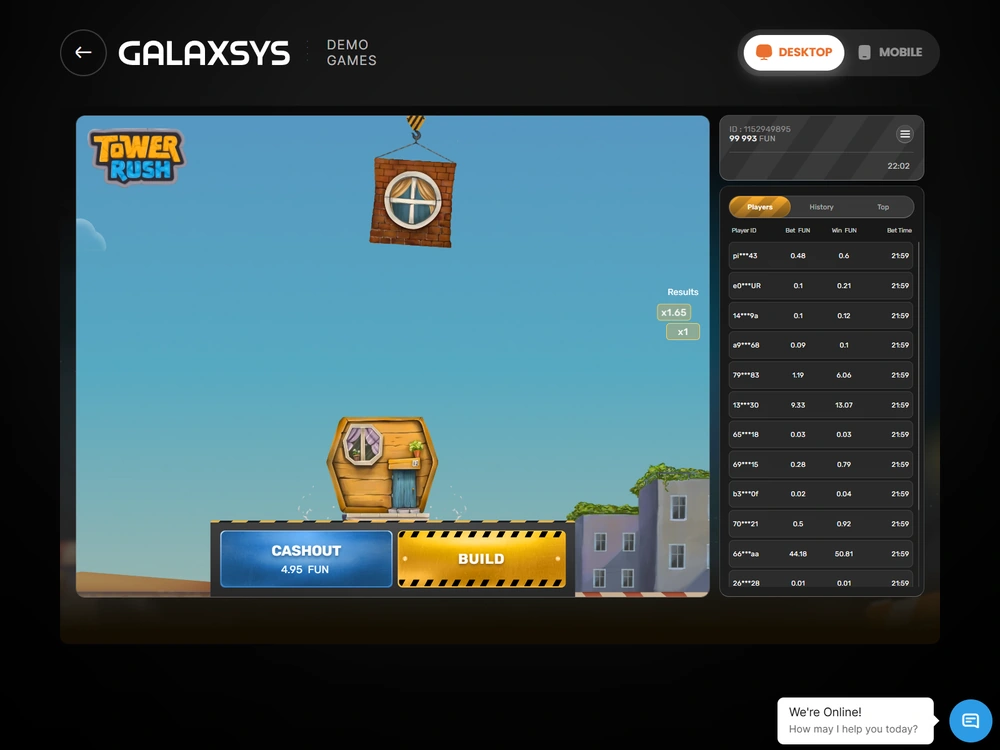
If another successful floor then multiplies the protected amount by 1.5 and you select Cashout, the same 17.50 FUN example settles at 65.63 FUN gross after rounding, for a net gain of 48.13 FUN. The protected amount is already included in the final credit. Adding it again would count part of the same payout twice.
Temple Floor multiplies the amount already built when the wheel lands on a multiplier. If it lands on Frozen, the accumulated amount is protected. A 12.50 FUN stake at 2.2× with a Temple result of 3× produces 82.50 FUN gross and 70.00 FUN net. The wheel has ten sectors, but the number of sectors alone cannot tell you the chance of landing on one. Triple Build adds three floors to the existing round with the original stake. See the bonus floor rules for how each feature works.
How to check a settled round
Check the accepted stake and the final credit in the same round before you calculate net. An amount on the tower while the round is active is still subject to the rules of the next Build. The game balance receives a confirmed Cashout, while a withdrawal from an operator’s cashier is a separate transaction.
- Open History and select the round. Match the round ID, the original stake and the wallet unit before you use any multiplier.
- Check whether the round settled, was voided or is still pending. For a settled round, compare the final gross with the credited amount and subtract the stake once.
- For a technical void, match the refund to the original debit and exclude both from settled-round turnover. If a round is pending, wait for its final status before counting it. After a connection failure, check the original ID before repeating the request.
In a reconnection example, a 6.50 FUN stake settled at 1.8× for 11.70 FUN gross and 5.20 FUN net. Reopening the history showed the same credit. Counting it twice would inflate the session return even though the wallet had received one payment. To check the outcome itself, see how to verify a round result.
Tower Rush at operators
7 operator reviews
These reviews cover different markets and test profiles. None of these operators offers authorised real-money Tower Rush in France.
-
 Profile score 6.1/10
Tested scenarios
- The international catalogue lists the Galaxsys original.
- The EUR test used Cartes Bancaires and SEPA Instant.
- The game earned 0% wagering credit in the tested welcome offer.
-
 Profile score 6.8/10
International platform
- The EUR test used Mastercard and SEPA Credit Transfer.
- An identity check preceded the first test withdrawal.
- Mini Games earn no wagering credit in the international Welcome.
-
 Profile score 6.3/10
Tested scenarios
- The separate 1w catalogue lists Tower Rush 2.
- The EUR cashier test used Visa and SEPA.
- The game earned 0% wagering credit in the tested welcome offer.
-
 Profile score 6.8/10
International platform
- The international listing gives the original 97% RTP.
- Clause 14.3 excludes players in France.
- Dragon Tower is a separate game.
-
 Profile score 6.3/10
Russian sportsbook
- RUB 100 minimum for deposits and withdrawals in the Russian sportsbook.
- The separate EUR test used a named bank account.
- The game earned 0% wagering credit in the EUR welcome test.
-
 Profile score 6.6/10
International platform
- The November Galaxsys Challenge listed the original.
- Betify excludes France from registration.
- Low turnover can trigger a withdrawal fee of up to 10%.
-
 Profile score 4.9/10
French platform
- ANJ authorisations cover sports betting, horse racing and poker.
- €10 minimum for deposits and ordinary withdrawals.
- French apps on Google Play and the App Store.
Expected loss on equal turnover
At 97% RTP, €250 of settled turnover has an expected gross of €242.50 and an expected net of −€7.50. The Tower Rush theoretical return calculation multiplies turnover by the applicable RTP, expressed as a decimal. Expected net subtracts the same turnover. The denominator is every settled stake in the calculation, including stakes made with funds already paid back in previous rounds.
| RTP used | House edge | Expected gross | Expected net |
|---|---|---|---|
| 97% | 3% | €242.50 | −€7.50 |
| 96.2% | 3.8% | €240.50 | −€9.50 |
The two rates differ by 0.8 percentage points. On the same turnover and without reaching a payout cap in this comparison, that is a €2.00 difference in expected loss, or 21.05% of the €9.50 loss at the lower rate. A wallet can generate €250 in turnover without starting at €250 if returned funds are staked again. The expectation does not specify how much of that turnover any one wallet will complete.

Why RTP alone cannot tell you the payout frequency
A 97% RTP can arise from many payout distributions, each with a different mix of payout amounts and frequencies. The binary benchmark used for comparing staking policies pays 2× with probability 0.485 and zero otherwise, giving 0.485 × 2 = 0.97 gross per unit staked. Its 48.5% hit probability belongs to that benchmark. The original game uses successive floor outcomes and feature multipliers, so you cannot infer its floor odds by dividing 97% by a target multiplier.
The benchmark compares four policies over 16,000 runs each, using the same independent outcome sequences and up to 30 rounds per run. Each run starts at €50 and also stops if the balance after settlement is €30 or less or €70 or more. With a fixed €1.50 stake, mean turnover is €44.86 and mean net is −€1.35. The fifth, median and 95th percentiles of net are −€15.00, €0.00 and €12.00. Those percentiles describe run outcomes. The €0.06 standard error describes how precisely the simulation estimates the mean. The risk scenarios cover how changing stakes and stop conditions affects exposure.
What the demo actually returned
The demo paid 283.44 FUN on 250.00 FUN of settled stakes, for an observed return of 113.376% and a net gain of 33.44 FUN. I tracked each accepted Build on a Samsung Galaxy S25 FE from its initial debit to its payout, zero result or refund. The session started at 750.00 FUN and ended at 783.44 FUN after a 27-minute window.
| Measure | Observed result |
|---|---|
| Accepted cycles | 24 total, 23 settled and 1 void |
| Initial debits | 254.00 FUN |
| Technical refund | 4.00 FUN |
| Settled turnover | 250.00 FUN |
| Gross payouts | 283.44 FUN |
| Net gain | +33.44 FUN |
| Gross ÷ settled turnover | 113.376% |
| Mean of individual round gross ÷ stake ratios | 1.176149 |
| Positive gross | 13 of 23 settled rounds (56.5217%) |
| Positive net | 12 of 23 settled rounds (52.1739%) |
| Break-even payout | 1 of 23 settled rounds |
| Largest gross credit | 44.10 FUN |
| Feature events | 4 total, including 2 Frozen Floors, 1 Temple Floor and 1 Triple Build |
The cancelled round debited 4.00 FUN and returned the same amount as a refund. Counting it as both a stake and a win would change the denominator and misclassify the credit. After the session, a separate −33.44 FUN wallet adjustment took the balance back to 750.00 FUN. Pending stakes totalled 0 FUN at close. That adjustment left the settled game result of +33.44 FUN intact.
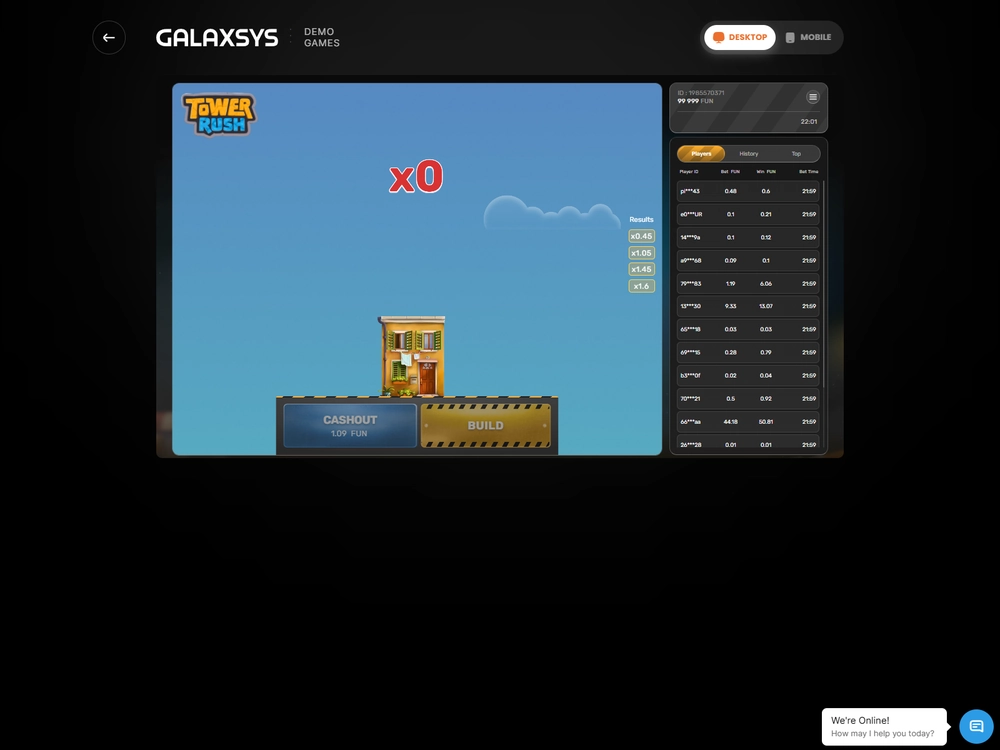
The turnover-weighted return and the mean round ratio answer different questions. Dividing the total gross by turnover gives each staked FUN equal weight. Averaging individual gross-to-stake ratios gives every settled round equal weight, even when one round risks several times the stake of another. The mean round ratio of 1.176149 therefore measures a different quantity from the return on all the FUN staked.
Payout frequency, profit and variation
A round can pay and still contribute zero profit. In one round the stake and the gross credit were both 5.00 FUN, so that round counts in 13 positive payouts but stays out of the 12 profitable rounds. The other ten settled rounds paid zero. The Wilson 95% interval of 36.8114%–74.3654% applies to the positive-payout frequency. It gives no interval for the theoretical RTP or the average size of a payout.
Across the settled rounds, the sample variance of net was 160.719379 FUN², calculated with the sample denominator of 22, and the standard deviation was 12.677515 FUN. The largest decline from a prior peak at round close was 23.80 FUN. The longest run of negative net was 2 settled rounds. Those measurements describe the swings in this particular session, which finished ahead despite several rounds with zero payout.
Which return figure should you use?
Use the configured Tower Rush RTP to calculate expected gross on a stated turnover. Use the profile’s cap for the maximum gross on one settled round, and the session return for the rounds actually observed. The 97% model and the 113.376% result answer different questions. If you are reading the figures from France, the FUN ledger shows how to reconcile a virtual session and the EUR example shows how the calculation works.
For the sequence from Build to payout, open the round rules. For how the site separates published rates, settlement records and model assumptions, see the methodology.

Frequently asked questions
Can I select the Tower Rush RTP by changing my stake?
You can select an amount on the permitted stake grid. The integration sets the RTP. Changing the stake changes the amount exposed and can change how much of a raw multiplier fits under the payout cap.
Does 97% RTP mean 97 of 100 rounds pay?
No. It means 97 units of expected gross for every 100 units of comparable turnover at that rate. To calculate payout frequency, count rounds with gross above zero and divide by the number of settled rounds.
Does the 10,000 FUN cap mean a cash prize in France?
FUN is the virtual wallet unit in the demo. The 10,000 FUN cap applies to a single demo round. The separate EUR cap describes an isolated settlement profile, and the ten operator profiles examined have no authorised real-money route for the game in France.
Can a demo finish above 100% return with a 97% theoretical rate?
Yes. A session exceeds 100% when its total gross exceeds settled turnover. The 23-round demo finished above that line. The theoretical rate describes the expectation under the selected profile, while the demo percentage describes the payouts on those specific rounds.

| Author | Gaspard Joly |
|---|---|
| Role | Senior iGaming, gambling and betting analyst |
| Experience | 9+ years analysing game providers, online gambling and payment systems |
| Published | 10 November 2026 |
| Device | Samsung Galaxy S25 FE, Android 16, One UI 8 |
| Methodology | Methodology |
Play responsibly
 Play responsibly
18+. Gambling can cause financial and personal harm. Set personal limits. For support, visit GamCare or GambleAware. See responsible gambling in France for local options.
Publisher and supplier licence
Digitain (MT) Limited · Malta Gaming Authority
MGA/B2B/592/2018
Tower Rush France is the publisher of this site. Galaxsys supplies the game. The Malta Gaming Authority issued critical gaming supply licence MGA/B2B/592/2018 to Digitain (MT) Limited on 29 January 2020. The company is registered in Malta under C 87254 at Tower Business Centre, 2nd Floor, Office 230, TRIQ IT-TORRI, Swatar Birkirkara, BKR 4013, Malta. Its UK Gambling Commission account number is 63601.
This B2B licence covers game supply. French operator permissions are listed separately by the ANJ. Malta Gaming Authority licence register · ANJ operator register