Français




Tower Rush strategies and risk come down to what you can afford to lose. No strategy, website or author can guarantee a win, a profit or any particular gambling result. Use the examples only to compare spending and exposure. Losses remain possible under every rule, and chasing a loss puts more of the remaining balance at risk.
Tower Rush strategies and risk under the same assumptions
All four staking rules face the same odds in the comparison. Each independent cycle returns twice the stake on a win and zero on a loss. The 48.5% win probability gives an expected gross return of 0.485 × 2, or 97% of turnover.
The 48.5% assumption applies only to the binary model, whereas the original Galaxsys game uses successive floors with multipliers and features that can change the payout within a round.
Each rule was evaluated on the same 16,000 outcome sequences. Every run began with €50 and allowed up to 30 cycles, with stakes on a €0.05 grid. The €20 stop-loss and €20 take-profit were checked after each settlement. They ended the run at a balance of €30 or less or €70 or more, respectively. Before accepting another stake, the model also stopped if the amount required exceeded the €20 stake cap or the funds remaining.
Fixed stake and 2% of the remaining balance
A fixed €1.50 keeps the next debit predictable. Across all 30 cycles, it adds up to €45 in turnover. Stakes count towards turnover even when you fund them with earlier payouts. Early stops brought the model average down to €44.86.
The percentage rule starts at €1.00 and recalculates 2% against the balance on the €0.05 grid. A falling balance can move the next stake to a lower grid step, while a rising balance can move it to a higher one. This rule began with a smaller stake than the other three, so its lower turnover reflects both the starting amount and the way it adjusts as the balance changes.
Linear progression and doubling
The linear progression adds €0.65 after each loss and resets to €1.50 after a win. Each increase is the same size, but successive losses add increasingly large stakes to the total. That makes exposure grow faster than with a flat stake.
Under the doubling rule, a loss doubles the next stake. Four opening losses at €1.50, €3.00, €6.00 and €12.00 consume €22.50 and leave €27.50. The stop-loss has already triggered by then. A fifth stake would require €24.00, above the €20 per-stake cap even though the remaining balance could cover the amount. In this sequence the loss threshold ends the run first. The cap can end other runs when the balance is still above the loss threshold.
What the 16,000 matched sequences show
All four mean net results were negative. The percentage rule produced the narrowest spread between the lower and upper percentiles. The linear rule had the highest mean turnover. It also had the largest mean net loss in this comparison.
| Staking rule | Mean turnover | Mean net | P05 / P50 / P95 net | Standard error of mean net |
|---|---|---|---|---|
| Fixed €1.50 | €44.86 | −€1.35 | −€15.00 / €0.00 / +€12.00 | €0.06 |
| 2% of balance | €29.75 | −€0.90 | −€9.35 / −€0.45 / +€8.35 | €0.04 |
| Linear progression | €59.40 | −€1.79 | −€23.00 / −€0.40 / +€16.55 | €0.09 |
| Doubling | €56.86 | −€1.76 | −€22.50 / −€9.00 / +€21.00 | €0.14 |
P05 is the fifth percentile, P50 the median, and P95 the 95th percentile of closing net results, including runs that ended early. In the doubling row, the upper percentile is positive while the median is a €9.00 loss.
Standard error measures the precision of the estimated mean, calculated as the standard deviation of run results divided by the square root of 16,000. The €0.03 gap between the progression means is small relative to the standard errors shown.
| Staking rule | Stop-loss | Insufficient balance | Stake cap |
|---|---|---|---|
| Fixed stake | 254 | 0 | 0 |
| 2% of balance | 0 | 0 | 0 |
| Linear progression | 2,443 | 0 | 0 |
| Doubling | 2,245 | 0 | 7,837 |
The cap ended nearly half the doubling runs. Comparing only the stop-loss column would make doubling look less exposed than the linear rule by missing that separate reason for stopping. No run ended for insufficient balance under these particular settings. A zero in the percentage row means none of those sequences reached the listed triggers under that rule. Runs could also finish at the cycle limit or the profit threshold.
Apply the limits before the next Build
Compare the full next stake with the amount left before your balance floor. A stop-loss checked after settlement only ends a session once the balance reaches its threshold. If the last accepted round loses, it can carry you through that floor, as the €27.50 closing balance in the doubling example shows. A game can accept a stake that falls outside your personal budget.
Stake and balance checks
- Write down a separate session budget, the lowest balance you are willing to reach and a maximum debit per round. Keep the time limit separate from the money limit.
- In the FUN demo, check the displayed currency and stake before selecting Build. Compare the amount with both the per-round ceiling and the room left before your balance floor. Stop if losing the full stake would cross that floor.
- After Build is accepted, include the debit in your exposure immediately. If the result is still pending, open History and check the round ID and status before taking another action.
- Once the round settles, record the payout or refund, then check the closing balance and the time left. End the session when either limit is reached.
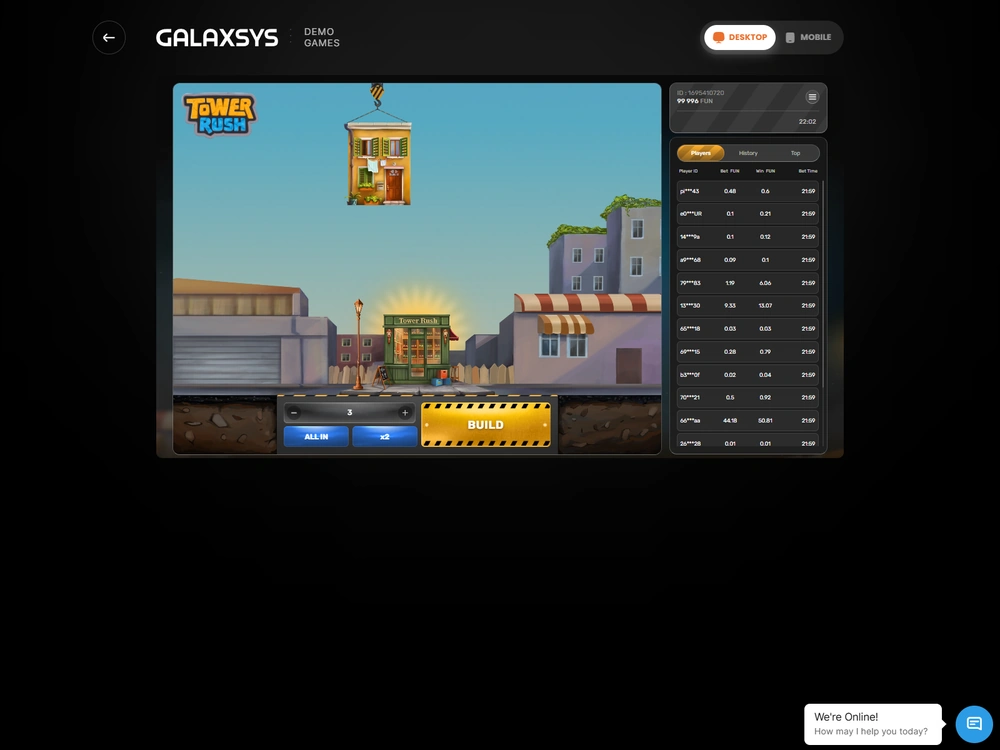
Tower Rush risk management starts with distinguishing the amount accepted from the amount still in play on screen. The original game takes one initial debit. A further Build in the same round puts the unprotected accumulation at risk without creating a separate paid round. Triple Build also uses the original stake for its three additional floors. Cashout settles the game round and credits the game balance. See the Build and Cashout rules for the full sequence.
Payout ceilings and round exposure
The payout ceiling is a separate control. The FUN profile allows stakes from 1 to 100 FUN in increments of 0.50 FUN and caps the round payout at 10,000 FUN. An isolated EUR profile uses stakes from €0.50 to €50.00 in €0.05 increments, with a €2,500 payout ceiling.
In that EUR profile, a €50.00 stake at a raw 64× gives €3,200 before the cap, €2,500 in gross payout and €2,450 net. The model’s €20 cap applies to the incoming stake. In the game, reaching a payout ceiling can still leave the unprotected amount exposed if you continue.
Loss-limit changes in the control scenario
In a separate limit-control scenario, the €20 net-loss setting was checked at settlement. Lowering it took effect immediately. Raising it took effect 48 hours after confirmation. Any existing reserve stayed in place. The simulation held its loss threshold fixed throughout each run.

What one FUN session shows about exposure
My demo session on a Samsung Galaxy S25 FE ended ahead despite a peak-to-trough drawdown of 23.80 FUN across settled balances. I started with 750.00 FUN and recorded 24 accepted Build cycles before the 27-minute session window closed.
Reconciling the demo ledger
I paired each debit with its final outcome. Of 254.00 FUN initially debited, 4.00 FUN came back as a refund on the single void round, leaving 250.00 FUN of comparable turnover across 23 settled rounds.
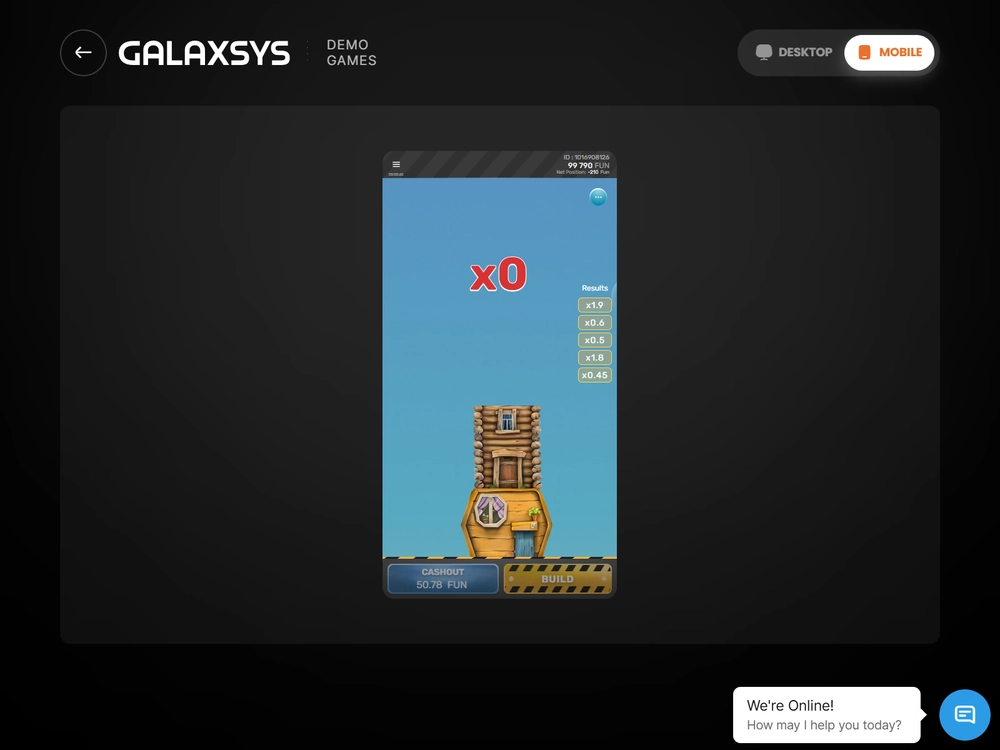
I counted 283.44 FUN of gross payouts and a session net of +33.44 FUN. The closing balance was 783.44 FUN. Nothing was pending. A separate reset later restored the balance to 750.00 FUN.
The session return was 113.376% of turnover, with each round weighted by its stake. Giving every round equal weight produces the simple average gross-to-stake ratio of 1.176149.
Payout frequency and round variability
One payout returned exactly the stake. That is why there were 13 positive payouts out of 23 rounds (56.5217%) and 12 profitable rounds (52.1739%). The longest sequence of net losses lasted two settled rounds. A short streak in this session provides no ceiling on the length of a future streak. The 95% Wilson interval for positive payouts ran from 36.8114% to 74.3654%, illustrating the uncertainty in even this narrowly defined frequency.
I recorded four feature events: two Frozen Floors, one Temple Floor and one Triple Build. In one round, a 12.50 FUN stake reached 2.5× at Frozen Floor. The subsequent fall settled for the protected 31.25 FUN. That was one payout with an 18.75 FUN net gain. The largest gross payout in the session was 44.10 FUN. Round net results had a sample variance of 160.719379 FUN², equivalent to a standard deviation of about 12.68 FUN.
Pending and reconnect cases
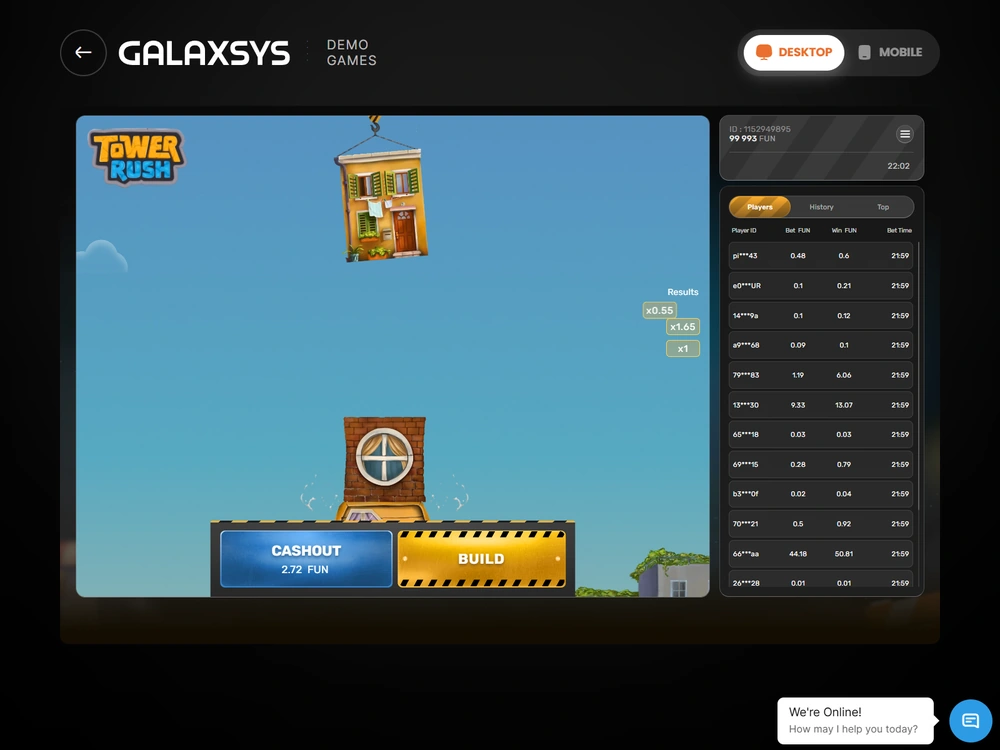
A separate 13.00 FUN debit counted against available funds while the round was pending, then ended with zero net and zero comparable turnover when a technical void refunded the full stake.
If the animation stalls, check the server’s round status in History. In one reconnect control, the 1.8× result paid 11.70 FUN on a 6.50 FUN stake. History still held a single credit when reopened, so the net remained +5.20 FUN.
Tower Rush at operators
7 operator reviews
These reviews cover different markets and test profiles. None of these operators offers authorised real-money Tower Rush in France.
-
 Profile score 6.1/10
Tested scenarios
- The international catalogue lists the Galaxsys original.
- The EUR test used Cartes Bancaires and SEPA Instant.
- The game earned 0% wagering credit in the tested welcome offer.
-
 Profile score 6.8/10
International platform
- The EUR test used Mastercard and SEPA Credit Transfer.
- An identity check preceded the first test withdrawal.
- Mini Games earn no wagering credit in the international Welcome.
-
 Profile score 6.3/10
Tested scenarios
- The separate 1w catalogue lists Tower Rush 2.
- The EUR cashier test used Visa and SEPA.
- The game earned 0% wagering credit in the tested welcome offer.
-
 Profile score 6.8/10
International platform
- The international listing gives the original 97% RTP.
- Clause 14.3 excludes players in France.
- Dragon Tower is a separate game.
-
 Profile score 6.3/10
Russian sportsbook
- RUB 100 minimum for deposits and withdrawals in the Russian sportsbook.
- The separate EUR test used a named bank account.
- The game earned 0% wagering credit in the EUR welcome test.
-
 Profile score 6.6/10
International platform
- The November Galaxsys Challenge listed the original.
- Betify excludes France from registration.
- Low turnover can trigger a withdrawal fee of up to 10%.
-
 Profile score 4.9/10
French platform
- ANJ authorisations cover sports betting, horse racing and poker.
- €10 minimum for deposits and ordinary withdrawals.
- French apps on Google Play and the App Store.
Pace changes the cost even at the same stake
Reducing the number of paid cycles reduces turnover at a fixed stake. In a 20-minute illustration with four minutes of pauses, 16 active minutes leave 40 windows of 24 seconds. Taking part in 60% of them gives 24 paid cycles. At €1.50 each, turnover is €36.00. At the model’s 97% return, the expected loss is €1.08. The window length is an input to this example, separate from the time a real round takes to settle.
The same turnover lets you isolate the effect of the return assumption. At €250 and 97%, the expected gross is €242.50 and the expected net is −€7.50. At 96.2%, those values are €240.50 and −€9.50. The 0.8 percentage-point gap represents €2.00 less expected loss at the higher return, about 21.05% of €9.50. Both calculations assume the payout cap is unreached. See how theoretical return is calculated for the configuration details.
What a winning clip leaves out
A selected win tells you little about the odds of repeating it. If a particular outcome has a 10% chance on each of 20 independent attempts, there is an 87.8423% chance that it occurs at least once. A clip can show that one success and leave 19 attempts out of view.
Before a Tower Rush round, you can see the stake controls and rules, while the confirmed outcome and payout arrive after settlement. For claims based on timing or past results, see how to assess prediction and signal claims.
What this means in France
For readers in France, none of the ten operator profiles assessed offers an authorised real-money route to Tower Rush. Betclic France’s authorisations cover sports betting, horse racing and peer-to-peer games such as poker. A French interface, a euro balance, a foreign licence or a working demo can all exist independently of French authorisation. Check the ANJ register of authorised operators for the categories an operator may offer.
When comparing Tower Rush strategies and risk, judge each rule by how much it can commit before you can stop. Fixed stakes make the next debit predictable, a percentage rule can step down as the balance falls, and progressions concentrate exposure during losses. Treat the euro examples as calculations and the FUN balance as virtual. For practical limits and support in France, see responsible gambling and session limits.

FAQ
Does a 1× Cashout count as a profitable round?
No. A 1× Cashout returns the original stake as the gross payout, so net is zero. A technical void also has zero net after the refund, but it is excluded from comparable settled turnover.
Can I treat Frozen Floor protection as available balance?
Wait until the round settles. Frozen Floor protects the accumulated amount within the round. If a later Cashout pays more, you receive the higher final payout once. The protected amount is already included in it.
What does x2 change in the demo?
The x2 control in the demo adjusts the stake amount. An existing round’s accumulation follows its accepted stake, floor outcomes and settlement. Check the stake field before Build, particularly after using x2 or All In.

| Author | Gaspard Joly |
|---|---|
| Role | Senior iGaming, gambling and betting analyst |
| Experience | 9+ years analysing game providers, online gambling and payment systems |
| Published | 10 November 2026 |
| Device | Samsung Galaxy S25 FE, Android 16, One UI 8 |
| Methodology | Methodology |
Play responsibly
 Play responsibly
18+. Gambling can cause financial and personal harm. Set personal limits. For support, visit GamCare or GambleAware. See responsible gambling in France for local options.
Publisher and supplier licence
Digitain (MT) Limited · Malta Gaming Authority
MGA/B2B/592/2018
Tower Rush France is the publisher of this site. Galaxsys supplies the game. The Malta Gaming Authority issued critical gaming supply licence MGA/B2B/592/2018 to Digitain (MT) Limited on 29 January 2020. The company is registered in Malta under C 87254 at Tower Business Centre, 2nd Floor, Office 230, TRIQ IT-TORRI, Swatar Birkirkara, BKR 4013, Malta. Its UK Gambling Commission account number is 63601.
This B2B licence covers game supply. French operator permissions are listed separately by the ANJ. Malta Gaming Authority licence register · ANJ operator register