Français



Which evidence answers which question
Galaxsys’s original Tower Rush is identified by the game title and studio together. The game overview covers that version’s Build and Cashout mechanics. Tower Rush 2 and Tower Rush Branded each have their own product records. The same identity check keeps Stake’s Dragon Tower separate when a catalogue search returns several games with similar names.
To understand how Tower Rush was evaluated, follow each claim from the source to its market and configuration, then from the event record to the calculation and conclusion. The provider’s game card establishes mechanics and stated parameters. Operator terms and store listings describe the products, markets and channels they name. The ANJ register establishes the scope of French operator authorisation.
Configuration matters even when the title matches. Galaxsys’s game card gives an RTP range of 96.2%–97.6%, while the demo rules and a provider catalogue specify 96.17%–97%. The demo calculation uses a fixed input of 97%. Third-party catalogue values stay with the profiles those catalogues describe. The configuration label tells you which return assumption went into the calculation.
An interface can show a balance or a button. A round history can show whether a particular request was accepted and settled. Checking a specific round’s cryptographic outcome requires its commitment, exact inputs and their encoding, the protocol version, as well as the mapping from the digest to the outcome. The fairness guide explains that separate check.
How the FUN session was measured
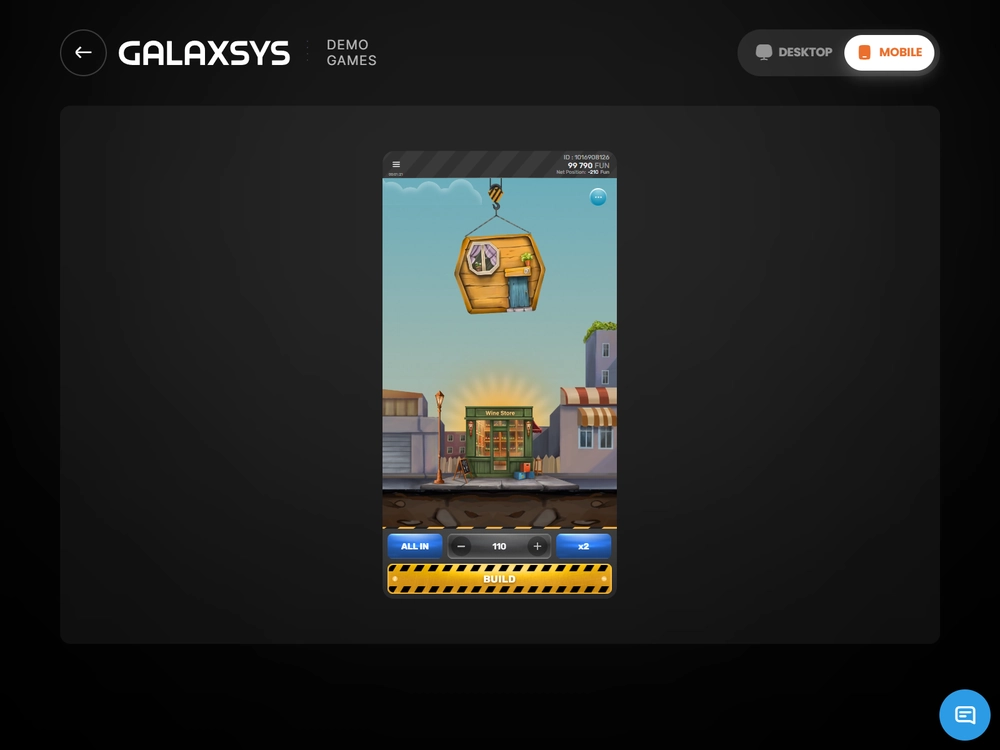
The primary game test used the Galaxsys demo on a Samsung Galaxy S25 FE with Android 16 and One UI 8. I opened the demo on Orange Wi-Fi in France and tracked the balance through a 27-minute session. I recorded each accepted debit and its matching settlement or refund, then reconciled the history at the end. The measurement of acceptance starts with the Build request and ends at server acceptance. Pauses between rounds belong to the session window.
| Ledger measure | Recorded result | Treatment in the calculation |
|---|---|---|
| Opening wallet | 750.00 FUN | Starting point for balance reconciliation |
| Accepted Build cycles | 24 | 23 settled rounds and 1 technical void |
| Initial debits | 254.00 FUN | Includes the debit for the voided round |
| Technical refund | 4.00 FUN | Reverses the voided debit |
| Comparable turnover | 250.00 FUN | Initial debits less the reversed debit |
| Gross settled payouts | 283.44 FUN | Includes each round’s final payout once |
| Net session result | +33.44 FUN | Gross settled payouts less comparable turnover |
| Closing balance | 783.44 FUN | Opening wallet plus net session result |
| Pending at close | 0 FUN | All accepted cycles resolved |
| Later wallet reset | −33.44 FUN | Separate adjustment back to 750.00 FUN |
How settlement changes the calculation
A settled round enters the sample once, even when it contains several Build actions. Frozen Floor locked in a value of 2.5× the 12.50 FUN stake before the tower fell. The protected amount produced a single 31.25 FUN gross credit and a net gain of 18.75 FUN. The protection belongs inside the final payout. Crediting it again would overstate both the wallet and the sample return.
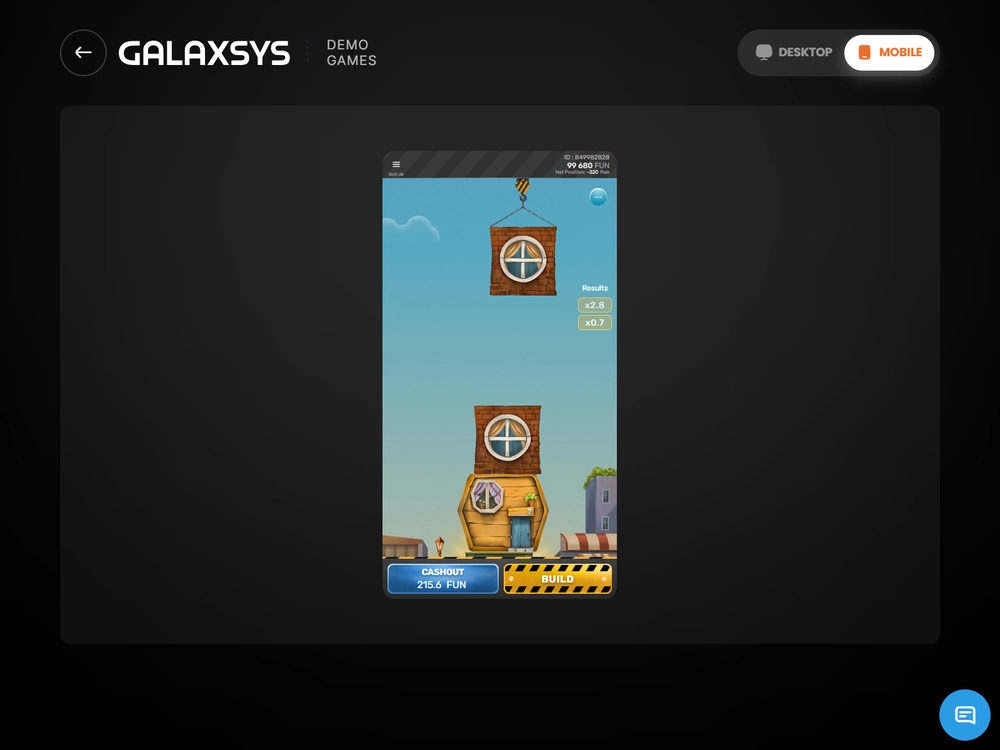
A technical void reverses the original debit. The 4.00 FUN refund therefore reduces the turnover used in the calculation. For a disconnection after acceptance, the recovery check reads the original round ID. In the 6.50 FUN recovery case, the history returned one gross credit of 11.70 FUN and the same result on a repeat read.
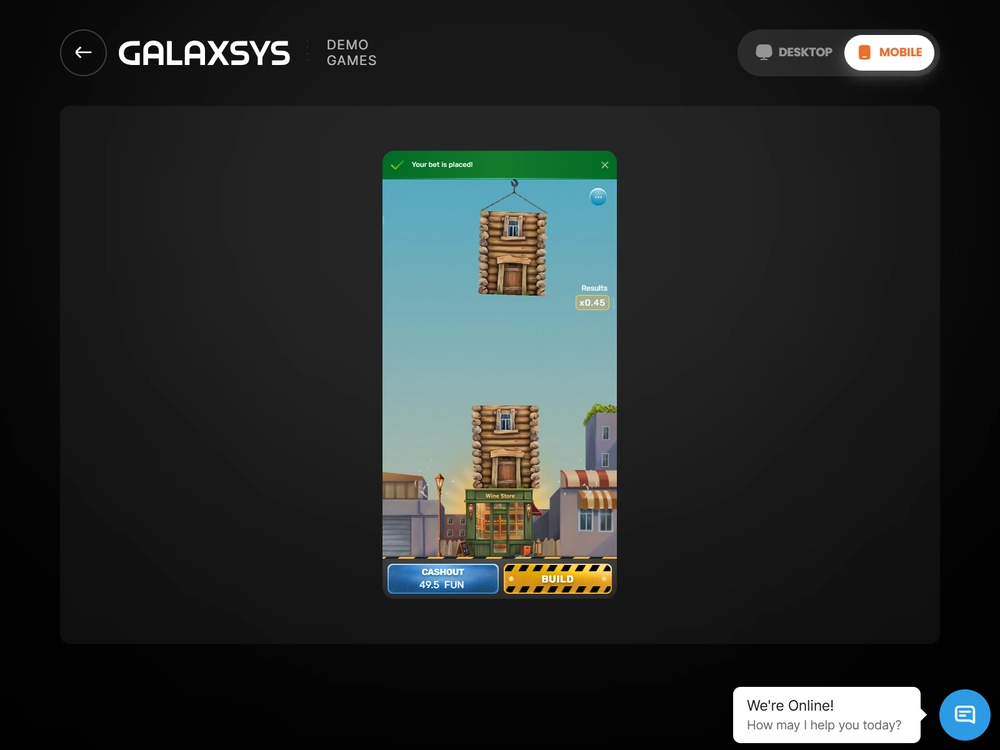
Use the round history to trace a balance discrepancy.
- Open the round history.
- Check the original round ID and its status. Record the state before and after acceptance.
- Match the debit to the credit for that round.
The player reports and complaints guide explains why a round settlement, a cashier operation and a support reply need separate records.
What the sample statistics describe
The observed return was 113.3760%, calculated as total settled gross divided by comparable turnover. The mean of the individual gross-to-stake ratios was 1.176149. In the first calculation, a round with a larger stake has more influence. In the second, every settled round has equal weight.
| Measure | Observed value | What it counts |
|---|---|---|
| Rounds with a payout | 13 of 23 (56.5217%) | Gross above zero, including 1 stake returned exactly |
| Profitable rounds | 12 of 23 (52.1739%) | Gross above the stake |
| Wilson 95% interval | 36.8114%–74.3654% | Interval for the positive-payout proportion |
| Feature events | 4 | 2 Frozen, 1 Temple and 1 Triple |
| Largest payout | 44.10 FUN | Maximum gross for one settled round |
| Sample variance of net | 160.719379 FUN² | Uses the settled sample with the n − 1 denominator |
| Standard deviation of net | 12.677515 FUN | Spread of round results in wallet units |
| Maximum drawdown | 23.80 FUN | Largest drop from a balance peak at round close |
| Longest losing run | 2 rounds | Consecutive settled rounds with negative net |
The interval is wide because the sample is small. The drawdown and losing run describe the order of events in that wallet. The demo configuration allowed stakes from 1 to 100 FUN in steps of 0.50 FUN and capped gross payouts at 10,000 FUN per round. The separate EUR ledger has its own €0.50–€50.00 grid, €0.05 step and €2,500 cap. Each cap belongs to its configuration.
How the model uses the same turnover
Expected return is calculated from a chosen RTP and a fixed turnover. At €250 of nominal turnover, 97% gives expected gross of €242.50 and expected net of −€7.50. At 96.2%, expected gross is €240.50 and expected net is −€9.50. A gap of 0.8 percentage points therefore changes expected loss by €2.00 on the same turnover.
The session percentage describes one sequence of FUN rounds. The expected values come from applying the selected rates to a common EUR input.
The policy model uses a separate binary benchmark with a 2× gross payout and a win probability of 0.485. Each policy uses the same 16,000 outcome sequences, with at most 30 cycles per run. The model isolates the effect of different staking rules under common inputs. Its binary probabilities belong to the benchmark.
See the RTP and game maths for the distinction between observed return and a long-run configuration parameter.
How mobile, payment and comparison checks are scoped
Client tests use matched conditions
APP-FR measures controlled client profiles with the device, network, cache and timed action recorded together. The Android environment used Chrome Stable 157.0.8103.46 and recorded Android System WebView 157.0.8103.46 as a separate field. The iPhone 17 used iOS and Safari 27.2. Its WebView container build and web resources have their own versions. The Windows 11 x64 desktop reference used Chrome Stable 157.0.8103.38 at 1,440 × 900 CSS pixels and 100% zoom to check layout.
The Orange Wi-Fi reference measured 112 Mbps down, 38 Mbps up and 23 ms control latency. Orange France 5G measured 51 Mbps down, 12 Mbps up and 49 ms. A cold run starts with an empty cache and a warm run uses retained resources. Comparisons hold the network and measured action constant.
A cold lobby run is timed from process launch until the lobby controls are usable. A game-launch run is timed from selection of the Tower Rush card until Build is usable and the FUN balance is visible. In the Betclic Android test profile, the FUN control was reached in 4 of 5 attempts. The successful attempts had a median of 2.952 seconds. The timeout stays in the success-rate denominator and outside the timing average. Betclic’s public native app is a separate channel from that controlled test profile.
Payment records separate the debit from the receipt
CASH-FR tracks requests, authorisation, credit, reserves, release and receipt by operator and operation. In a Betclic France control for an authorised product, the fourth withdrawal request within 24 hours used a €5.00 deduction. The €18.50 request yielded €13.50 received. The wallet reconciliation uses the full €18.50 outgoing amount. The fee explains the gap between that debit and the bank receipt.
The incoming and outgoing controls have separate starting conditions. A cashier scenario can illustrate the effect of a published rule for the product named in the control.
Offers are checked against the product they cover, the eligibility terms and the contribution rules. MyStake’s international welcome terms, for example, apply to slots and give Mini Games zero wagering contribution. That evidence describes the named international offer.
Game comparisons keep separate wallets
CMP-FR compares 18 distinct games, including 10 from Galaxsys, using a separate virtual wallet for each game and the same return arithmetic. The original’s comparison profile starts at 200.00 FUN and uses a 0.25 FUN stake step. A 6.50 FUN stake returned 19.18 FUN gross in that profile, leaving 212.68 FUN before a separate reset.
The comparison records a public demo button and the result of a launch as two observations. It measures similarity by the sequence of decisions, the type of outcome, the point of Cashout and the feature effects. Every trial wallet in this comparison is virtual.

How the ratings out of 10 are calculated
Each score names what was evaluated and under which conditions. Published rules and regulator records establish features, identity and access. A first-hand log measures the actual action in a named setup. For example, a controlled EUR transfer shows what happened on that route, while the terms define which customers and operations the rule covers.
On the 0–10 scale, 0–2 signals a critical failure or confirmed absence of an expected feature, 3–4 a weak result, 5–6 a functional result with meaningful limitations, 7–8 a strong result and 9–10 an exceptional result with strong evidence. Individual criteria use half-point steps. Compare like with like for speed, fees and limits. For example, compare matched withdrawal routes from request to receipt and keep any prior identity check separate. Transparency, stability and access use their own anchors. Standardised benchmarks can support comparable performance criteria when the feature and its scope are established.
The original Tower Rush in FUN
The game score weights mechanics and player control at 25%, clarity of stakes, payouts and risk at 25%, official FUN demo access and usability at 20%, clarity of outcome verification at 15%, and settlement and recovery at 15%. The weights belong to the original FUN configuration. The hash criterion reflects the published mechanism and visible verification controls. The payout and recovery criteria use the separate recorded round outcomes. See the calculation and scope on the original Tower Rush page.
Platform and tested-scenario scores
The platform model starts with licence and safety at 20%, casino and games at 20%, sportsbook at 15%, payments at 15%, bonuses at 10%, app and mobile at 10%, and support at 10%. The casino and games category combines slots (45%), live casino (30%), crash games (15%) and lobby discovery (10%). A score for tested operator scenarios uses the payments, bonuses and mobile models with starting weights of 15, 10 and 10 within that scope.
- Score each supported criterion against the relevant scale and multiply it by its criterion weight. Rebalance the scored weights within each category.
- For an overall platform or tested-scenario score, adjust the category weights for the share of criteria that can be scored. Rebalance the contributing weights to 100%.
- Add the weighted contributions and round the final score once to one decimal place.
Confirmed absence can lower an applicable score. Unknown values carry no score, and criteria outside the assessed product or scenario are excluded. A category requires sufficient support before it can contribute. A score changes when verified facts, terms or comparable results change within its market and scope. A France-only product, an international platform and a controlled test can yield different scores because they answer different questions. The separate FR-DOC-1 calculation below covers documentation.
Tower Rush at operators
7 operator reviews
These reviews cover different markets and test profiles. None of these operators offers authorised real-money Tower Rush in France.
-
 Profile score 6.1/10
Tested scenarios
- The international catalogue lists the Galaxsys original.
- The EUR test used Cartes Bancaires and SEPA Instant.
- The game earned 0% wagering credit in the tested welcome offer.
-
 Profile score 6.8/10
International platform
- The EUR test used Mastercard and SEPA Credit Transfer.
- An identity check preceded the first test withdrawal.
- Mini Games earn no wagering credit in the international Welcome.
-
 Profile score 6.3/10
Tested scenarios
- The separate 1w catalogue lists Tower Rush 2.
- The EUR cashier test used Visa and SEPA.
- The game earned 0% wagering credit in the tested welcome offer.
-
 Profile score 6.8/10
International platform
- The international listing gives the original 97% RTP.
- Clause 14.3 excludes players in France.
- Dragon Tower is a separate game.
-
 Profile score 6.3/10
Russian sportsbook
- RUB 100 minimum for deposits and withdrawals in the Russian sportsbook.
- The separate EUR test used a named bank account.
- The game earned 0% wagering credit in the EUR welcome test.
-
 Profile score 6.6/10
International platform
- The November Galaxsys Challenge listed the original.
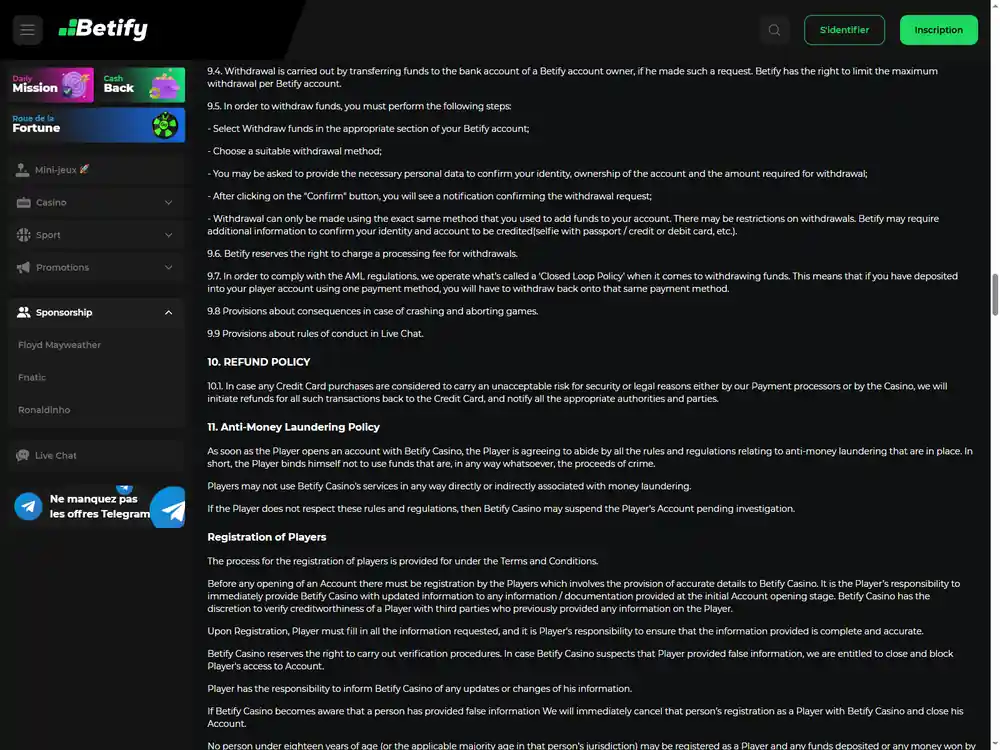
- Betify excludes France from registration.
- Low turnover can trigger a withdrawal fee of up to 10%.
-
 Profile score 4.9/10
French platform
- ANJ authorisations cover sports betting, horse racing and poker.
- €10 minimum for deposits and ordinary withdrawals.
- French apps on Google Play and the App Store.
How FR-DOC-1 scores documentation
FR-DOC-1 adds five weighted documentation criteria on a 0–100 scale. Each takes a value of 0, 0.5 or 1 for zero, partial or full credit within the criterion’s scope.
- Multiply each criterion value by its weight.
- Add the weighted contributions.
- Express the total to one decimal place.
| Criterion | Points available | Evidence used |
|---|---|---|
| Operator identity and market | 30 | The legal entity and scope of its market documents |
| Public card for the original game | 25 | A listing tied to the Galaxsys original and the scope it describes |
| Payment and offer rules | 20 | Published conditions for the relevant operations and offers |
| Mobile channels | 15 | Information about the relevant app and web routes |
| Complaint route | 10 | A documented route for raising an issue |
All weights stay fixed, including when a criterion scores zero. A profile with no points for the game card still has 25 points allocated to that criterion. Keeping the denominator fixed lets you compare documentation across profiles with different gaps.
| Profile | Identity | Original card | Payment and offers | Mobile | Complaints | Score / 100 |
|---|---|---|---|---|---|---|
| 1Win | 1 | 0 | 0.5 | 0 | 0 | 40.0 |
| Stake | 1 | 1 | 0.5 | 0 | 0.5 | 70.0 |
| MyStake | 1 | 0 | 1 | 0 | 1 | 60.0 |
| 1XBET | 0.5 | 0 | 0.5 | 0 | 0 | 25.0 |
| 4RABET | 0.5 | 0 | 0 | 0 | 0 | 15.0 |
| Melbet | 0.5 | 0 | 0 | 0 | 0 | 15.0 |
| Parimatch | 0.5 | 0.5 | 0.5 | 0 | 0 | 37.5 |
| Crorebet | 0.5 | 0 | 0.5 | 0.5 | 0 | 32.5 |
| Betify | 0.5 | 0.5 | 1 | 0.5 | 1 | 65.0 |
| Betclic | 1 | 0 | 1 | 1 | 1 | 75.0 |
Stake’s published international card identifies the original, giving it the full 25 points for that criterion. With 30 points for identity, 10 for payments and offers, and 5 for complaints, the documented total is 70.0. The Parimatch and Betify listings receive half credit for the game card because their evidence establishes the listing and has a narrower scope than a live launch.
Which profiles qualify for real-money play in France
All ten profiles are excluded from the French real-money Tower Rush list. Eligibility depends on the market and product category and is checked separately from the documentation score. Stake’s terms exclude France. Betclic’s 75.0 reflects strong documentation for its authorised French products, with zero credit for the original’s game card. Its ANJ authorisations cover sports betting, horse racing and circle games such as poker.
You can check authorised operators and their categories in the ANJ register. French eligibility requires authorisation for the relevant product category even when an operator has a French-language interface, a euro balance, a foreign operator licence or a public game listing. Galaxsys’s supplier licence likewise belongs to the business supplying the game. Tower Rush France excludes active affiliate links to real-money Tower Rush for France.
How to read a result on this site
- Open the operator and market comparison and check the eligibility result for France.
- Check the label beside the score. The /10 table identifies the product or tested scenarios it covers. The FR-DOC-1 table shows which parts of the operator’s documentation earned credit.
- For gameplay, open the comparison of Tower Rush and similar games. Check the version, wallet and configuration before comparing a measured result with a calculation.

Frequently asked questions
Can a profile score points without a Tower Rush game card?
Yes. Identity, payment and offer rules, mobile channels, and the complaint route can all contribute. Betclic earns 75.0 through those four criteria. The separate French eligibility check excludes it for real-money Tower Rush.
How can the demo return exceed the configured RTP?
The demo percentage divides the actual gross credits by the settled stakes in one session. The configured RTP describes a long-run expectation. A short sequence can land above or below that value, and its mix of stakes and outcomes determines the observed percentage.
Does a technical void count as a break-even round?
A technical void reverses the debit and is excluded from the settled sample. A settled round that pays exactly the stake remains in the sample, with a positive gross payout and zero net profit.
Where can I report a version or figure that needs correcting?
Email the Tower Rush France editorial team at [email protected]. Include the page URL and identify the version, figure or claim. If the issue concerns a wallet transaction for an authorised product, start with the operator and keep the transaction reference.

| Author | Gaspard Joly |
|---|---|
| Role | Senior iGaming, gambling and betting analyst |
| Experience | 9+ years analysing game providers, online gambling and payment systems |
| Published | 10 November 2026 |
| Device | Samsung Galaxy S25 FE, Android 16, One UI 8 |
| Methodology | Methodology |
Play responsibly
 Play responsibly
18+. Gambling can cause financial and personal harm. Set personal limits. For support, visit GamCare or GambleAware. See responsible gambling in France for local options.
Publisher and supplier licence
Digitain (MT) Limited · Malta Gaming Authority
MGA/B2B/592/2018
Tower Rush France is the publisher of this site. Galaxsys supplies the game. The Malta Gaming Authority issued critical gaming supply licence MGA/B2B/592/2018 to Digitain (MT) Limited on 29 January 2020. The company is registered in Malta under C 87254 at Tower Business Centre, 2nd Floor, Office 230, TRIQ IT-TORRI, Swatar Birkirkara, BKR 4013, Malta. Its UK Gambling Commission account number is 63601.
This B2B licence covers game supply. French operator permissions are listed separately by the ANJ. Malta Gaming Authority licence register · ANJ operator register